
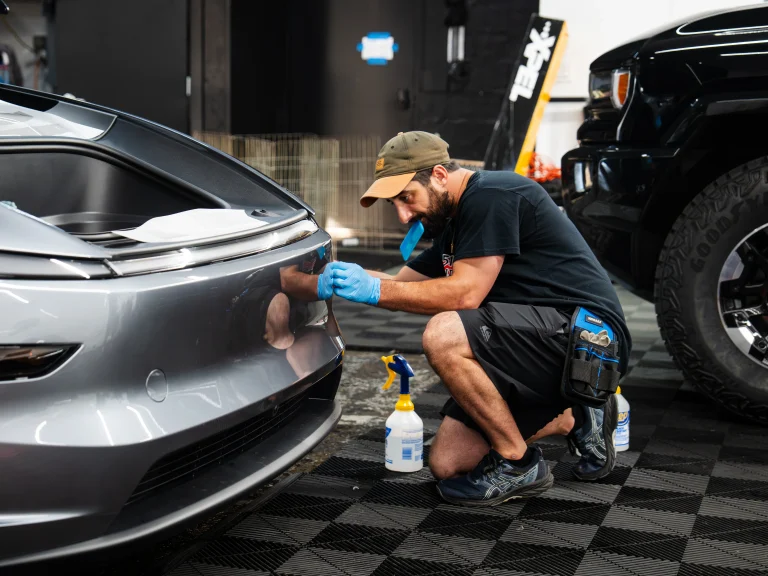
Paint protection film can protect a vehicle for years, but there is no single lifespan that applies to every car.
A weekend vehicle stored in a garage has a much easier life than a daily driver that spends hours on Massachusetts highways. One may see occasional rain and light use. The other deals with gravel, road salt, slush, bugs, sand, sun, and winter grime. Naturally, the film will age differently.
At Wrap and Detail Co in Westford, Massachusetts, we install XPEL ULTIMATE PLUS, which currently carries a 10-year manufacturer warranty. That gives vehicle owners a useful reference point, but we do not treat year 10 as an automatic replacement date. The condition of the film tells us more than the calendar does.
If the PPF is still clear, flexible, firmly attached, and protecting the paint, its age alone may not be a reason to replace it. Film that is cracking, lifting, badly stained, cloudy, or physically damaged deserves a closer look.
Key Takeaways
- The XPEL ULTIMATE PLUS is offered now with a manufacturer warranty up to 10 years.
- How fast PPF ages can depend on the mileage, highway use, winter roads (if applicable), outdoor parking and maintenance.
- Areas that see more exposure, like front bumpers and hoods, mirrors, and rocker panels can take a bit of punishment compared to some less exposed areas.
- Washing regularly prevents salt, bugs, sap and grime from sitting on the film.
- In most cases, a panel that has been damaged may be replaced without having to remove PPF installed on the entire vehicle.
- This makes lifting, cracking deep cuts haze and permanent staining a stronger signal for retirement than simple age.
How Long Does Paint Protection Film Usually Last?
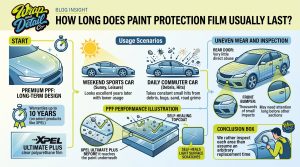
Premium paint protection film is designed for long-term use, and some products are backed by warranties lasting up to 10 years.
Real-world lifespan still depends heavily on how the vehicle is used.
A sports car driven on sunny weekends may have film that looks excellent years later. A commuter running up and down the highway every day is constantly taking small hits from debris, bugs, sand, and road grime.
That is exactly what PPF is supposed to handle.
XPEL ULTIMATE PLUS is a clear polyurethane film that takes damage before it reaches the paint underneath. Its topcoat can also self-heal light surface scratches. The wear will not always be even across the vehicle.
A front bumper may absorb thousands of small impacts while a rear door sees very little direct abuse. Because of that, one section may need attention long before the rest of the installation.
We would rather inspect how each area looks and performs than assume all PPF should be replaced after a certain number of years.
Ready for a Better-Looking Ride? Request a Quote Today!
CALL NOW (978) 815 0586
What Makes PPF Wear Out Faster?
Several factors can shorten the useful life of paint protection film.
Film Quality
Better-quality PPF, in general, will wear clear, and remain flexible with less staining for longer.
Less expensive films exhibit greater variability in adhesive characteristics, topcoat durability and the degree of clarity/flexibility. Material is not the only factor that relates to its lifespan, but it matters a lot.
Installation Quality
Good film still needs good installation.
The paint should be thoroughly cleaned before the material goes on. Dirt or contamination trapped underneath can affect the finished appearance.
Edges matter too. Poorly finished edges may start lifting or collecting dirt over time.
Curved bumpers, mirrors, tight corners, and complex body lines are especially demanding.
At Wrap and Detail Co, we pay close attention to preparation, positioning, edge work, and the final inspection. Those small details may not seem dramatic on day one, but they become more important as the film ages.
Highway Mileage
More miles usually mean more exposure.
Highway driving is particularly hard on the front of a vehicle because the bumper, hood, mirrors, and front fenders regularly catch small rocks, sand, bugs, and debris from surrounding traffic.
Most impacts are minor. Over thousands of miles, though, they add up.
That is why a bumper may eventually need fresh film while the rest of the vehicle still looks fine.
Massachusetts Winters
Vehicles in Massachusetts face extreme wear and tear when using winter roads.
The front bumper, rocker panels, wheel arches, and lower doors can build up dirt like salt brine, sand, and dirty snow slush.
PPF protects the paint below, but above sits dirt.
Keeping heavy winter build-up around for extended periods can make the film more challenging to maintain a clean appearance. While you need not wash the car all the time, regular cleaning in winter does have a huge impact.
Outdoor Parking
A car subjected to outdoor parking all year also has exposure to the sun, rain, snow, collecting pollen and bird droppings as well as tree sap, moisture, and temperature fluctuations.
Premium PPF is rated for outdoor use, but a vehicle that spends its entirety inside of a garage constantly faces less weathering stress than one that’s left to the elements on a daily.
How Can You Make PPF Last Longer?
You do not need a complicated maintenance routine.
Regular washing is usually the biggest thing.
Remove bugs, bird droppings, road salt, and tree sap before they remain on the surface for too long. Use cleaning products that are appropriate for PPF.
Pressure washing is generally fine, but avoid holding a high-pressure nozzle extremely close to the film edges. That is where water pressure is more likely to cause lifting.
Pay attention while you wash the vehicle too.
If an edge starts to lift, having it checked early is better than waiting for dirt and moisture to work underneath.
XPEL recommends waiting about 48 hours after installation before washing freshly installed ULTIMATE PLUS.
After that, maintenance mostly depends on how the vehicle is driven and stored.
How Do You Know When PPF Needs Replacement?
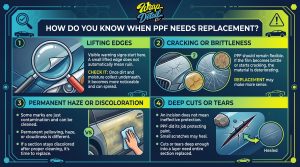
PPF usually gives you visible warning signs.
Lifting Edges
A small lifted edge does not automatically mean the entire section is ruined.
Still, it should be checked.
Once dirt and moisture begin collecting underneath, the lifted area can become more noticeable and may continue spreading.
Cracking or Brittleness
PPF should remain flexible.
If the film becomes brittle or starts cracking, the material may be deteriorating and replacement may make more sense than leaving it in place.
Permanent Haze or Discoloration
Some marks are simply contamination and can be cleaned.
Permanent yellowing, haze, or cloudiness is different.
Clear PPF should remain visually unobtrusive. If a section stays discolored after proper cleaning, it may be time to replace it.
Deep Cuts or Tears
An incision in the film does not necessarily mean that the protection was ineffective.
If the PPF takes a rock and is damaged while protecting the paint, it has done its job.
Small scratches on the surface may heal, but cuts or tears that are deep enough to reach into a layer normally need an entire section replaced.
Ready for a Better-Looking Ride? Request a Quote Today!
CALL NOW (978) 815 0586
Do You Have to Replace All the PPF at Once?
Usually, no.
One of the practical advantages of PPF is that individual sections can often be replaced.
If the front bumper is worn but the hood and fenders still look good, you may only need new film on the bumper.
We still check the surrounding material first.
Brand-new film can look slightly different next to older material that has already been exposed to years of sunlight, washing, and road use. That does not mean everything must be replaced, but it is worth considering before the work begins.
Should You Replace PPF After 10 Years?
Not automatically.
A 10-year warranty does not mean the film needs to come off the day it reaches 10 years old.
We would rather look at its condition.
If the PPF is still clear, flexible, well-adhered, and free from major damage, that is very different from film of the same age that is peeling, cracking, yellowing, or becoming brittle.
Age gives us context. Condition helps us make the decision.
Is PPF Worth It in Massachusetts?
For many drivers, PPF makes the most sense on areas that receive the most road impact.
Common areas include:
- front bumper
- hood
- front fenders
- mirrors
- rocker panels
You do not necessarily need full-body coverage.
Someone who drives occasionally and stores the car indoors may be comfortable with partial-front protection. A high-mileage commuter may get more value from full-front coverage or additional protection along the sides.
We look at mileage, road use, storage, ownership plans, and how important preserving the original paint is to the customer.
That usually leads to a better recommendation than putting every vehicle into the same package.
Paint Protection Film in Westford, MA
At Wrap and Detail Co in Westford, Massachusetts, we install XPEL Paint Protection Film with careful attention to preparation, fitment, clean edges, and the final appearance.
We are veteran-owned and operated, and our approach is straightforward: protect the areas that make sense for how the vehicle is actually used.
If your current PPF is lifting, stained, cracked, scratched, or simply getting older, we can inspect it and explain what we see.
Sometimes the film is still doing its job. Sometimes one section needs replacement. In other cases, starting fresh makes more sense.
Contact Wrap and Detail Co to schedule an evaluation and talk through the options for your vehicle.
Frequently Asked Questions
Q: How long is the warranty on XPEL ULTIMATE PLUS?
A: In reality, this can still depend on things like mileage, road conditions, storage, climate maintenance, and physical damage.
Q: Can you keep PPF for more than 10 years?
A: It can. Film that is still crystal clear, pliable, well-adhered, and would not show serious defects can continue to function after the warranty period has ended.
Q: Does parking outside affect the longevity of PPF?
A: Parking outdoors exposes you to more sun, rain, snow, and pollen as well as droppings from birds that perch on the car or tree sap that falls. Regular cleaning helps reduce buildup.
Q: Should I pressure wash a car with PPF?
A: Yes. Don’t spray at enormous volumetric waterfall pressure short of the film edges as that can likewise cause lifting.
Q: Does PPF turn yellow?
A: Premium modern PPF is made to withstand yellowing, but nothing lasts forever in the face of contamination and exposure over time.
Q: Is it true that scratches come off in PPF?
A: Depending upon your surface, the scratches could heal themselves with film that has a self-healing topcoat on it. Typically, deep cuts, punctures, and lacerations will not.
Q: If one piece of my PPF is damaged, do I have to replace all other parts as well?
A: Usually not. If the rest of the film is in good condition, individual panels or sections can often be replaced with lower tactility materials.
Our Services Include:
Whether you want to protect your vehicle’s paint, enhance its appearance, or give it a complete refresh, Wrap and Detail Co. is ready to help.
Need Professional Vehicle Protection? Get Your Free Quote Today!
Contact Wrap and Detail Co. to discuss your vehicle protection and detailing needs and find the right solution for your car.